Explains data redundancy elimination (DRE), a WAN compression technology that removes redundant information, uses a shared cache between peers, and replaces repeated data with short references to compress traffic over the overlay and reconstruct the original data at the destination.
A DRE is a WAN compression technology that
-
reduces the size of data transmitted over the WAN by removing redundant information before sending the data stream
-
uses a shared cache architecture where peers involved in compression and decompression share the same redundancy cache, and
-
replaces repeated data with short references when integrated with Cisco Catalyst SD-WAN, and reconstructs the data stream at the receiving end.
How DRE and TCP optimization work together
Cisco IOS XE Catalyst SD-WAN devices need to be deployed at both ends of the Cisco Catalyst SD-WAN overlay tunnel.
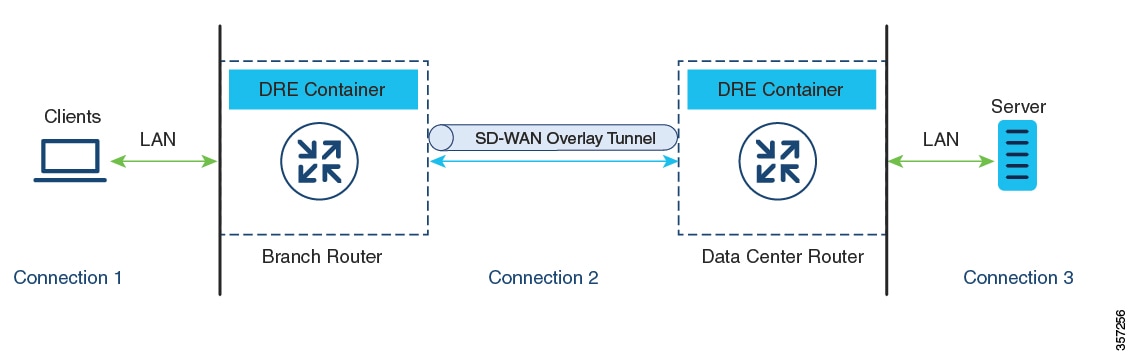
When DRE is configured, the TCP traffic is intercepted and it’s separated into three connections:
|
Connection Type |
Network |
|---|---|
|
Client to the branch Cisco IOS XE Catalyst SD-WAN device: This connection exists in Local Area Network (LAN) |
LAN |
|
Branch router to the data center router |
Through Cisco Catalyst SD-WAN overlay tunnel |
|
Remote branch or data center router to the server |
LAN |
TCP connections in the Local Area Network (LAN) continue to send the original data. However, TCP connections through the Cisco Catalyst SD-WAN overlay tunnel send data that is compressed by DRE. The DRE container in the Cisco IOS XE Catalyst SD-WAN device at one side of the tunnel compresses the data before it’s sent over the overlay tunnel. The DRE container in the Cisco IOS XE Catalyst SD-WAN device at the other side of the tunnel decompresses the data before it's sent to the server at the remote branch or data center side.
DRE Cache: DRE cache uses secondary storage so that it can store a large amount of data. DRE cache is stored on both sides of the WAN and is used by edge devices to decompress the data. DRE cache in both devices (branch and data center) is synchronized, which means that if a chunk signature is present on one side, the other side has it too.
DRE Compression: DRE uses the Lempel-Ziv-Welch (LZW) compression algorithm for compressing data. DRE operates on large streams of data, typically tens to hundreds of bytes or more, and maintains a much larger compression history.